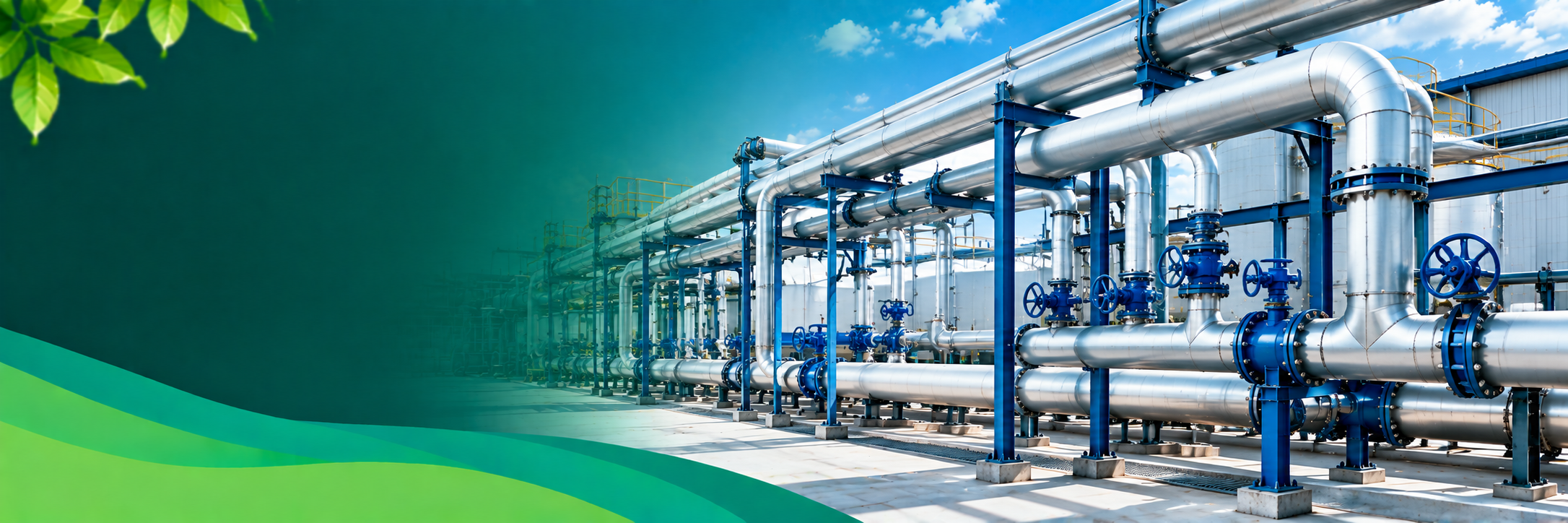
Piping
Reliable HVAC piping solutions designed for the movement of fluids across different pressure and temperature conditions within industrial and commercial facilities.
Reliable HVAC piping solutions designed for the movement of fluids across different pressure and temperature conditions within industrial and commercial facilities.
HVAC piping encompasses many different fluid, pressure & temperature conditions.
This piping can be located above or below ground and route through the interior or exterior of a building.
Typical space heat transfer is completed using an air-water coil designed to return the water at a defined temperature.
HVAC piping routes can be planned according to the system arrangement, fluid conditions, pressure, temperature and building layout.
HVAC piping provides the required routes for transferring fluids between different components of an HVAC installation.
Depending on the facility and system layout, piping may be routed above ground, below ground, inside a building or through exterior areas.
The piping arrangement can be integrated with HVAC equipment and heat-transfer systems according to the requirements of the application.
HVAC piping supports the controlled movement of fluids between system components. Air-water coils can be used for space heat transfer and are designed to return water at a defined temperature.
HVAC piping arrangements can vary according to fluid conditions, pressure, temperature and the physical layout of the facility.
HVAC piping provides passages for the controlled movement of fluids required by the system.
Piping systems may operate under different pressure conditions depending on the application and system requirements.
HVAC piping can be arranged to handle different fluid temperature requirements within the system.
Piping can be routed above ground according to the building and facility arrangement.
Where required, piping routes can also be located below ground as part of the overall installation.
Piping can be coordinated with HVAC equipment, coils and other system components.
HVAC piping can route through the interior or exterior of a building depending on the facility layout and system requirements.
The routing arrangement is planned to provide suitable connections between HVAC equipment and the required heat-transfer components.
Different installation routes can be considered according to the building structure and HVAC system arrangement.
HVAC piping creates a controlled route for moving fluids between system components and supporting heat-transfer requirements.
Fluid moves through the HVAC piping according to the requirements of the system.
The piping provides a controlled path between connected HVAC components.
Air-water coils can be used to complete space heat transfer within the HVAC arrangement.
The system is arranged to return water at the defined temperature required by the application.
A properly planned piping system helps connect HVAC equipment and provides suitable routes for fluid movement and heat-transfer applications.
Provides dedicated passages for transferring fluids between HVAC system components.
Supports HVAC applications involving different fluid temperature conditions.
Piping arrangements can be designed around the pressure conditions of the application.
Piping may be routed above or below ground and through interior or exterior areas.
Piping can be coordinated with HVAC equipment and air-water coil systems.
Supports space heat transfer applications using suitable air-water coil arrangements.
HVAC piping can be incorporated into different industrial, commercial and building utility systems.
Piping arrangements for industrial HVAC systems and facility utility requirements.
HVAC piping for commercial building heating and cooling system arrangements.
Piping arrangements supporting air-water coil based space heat-transfer applications.
Fluid piping infrastructure integrated with building and industrial utility systems.
Newtos Enviro can support HVAC piping requirements as part of integrated engineering and utility projects.
Piping arrangements can be coordinated with HVAC equipment, heat-transfer components and other facility systems according to project requirements.