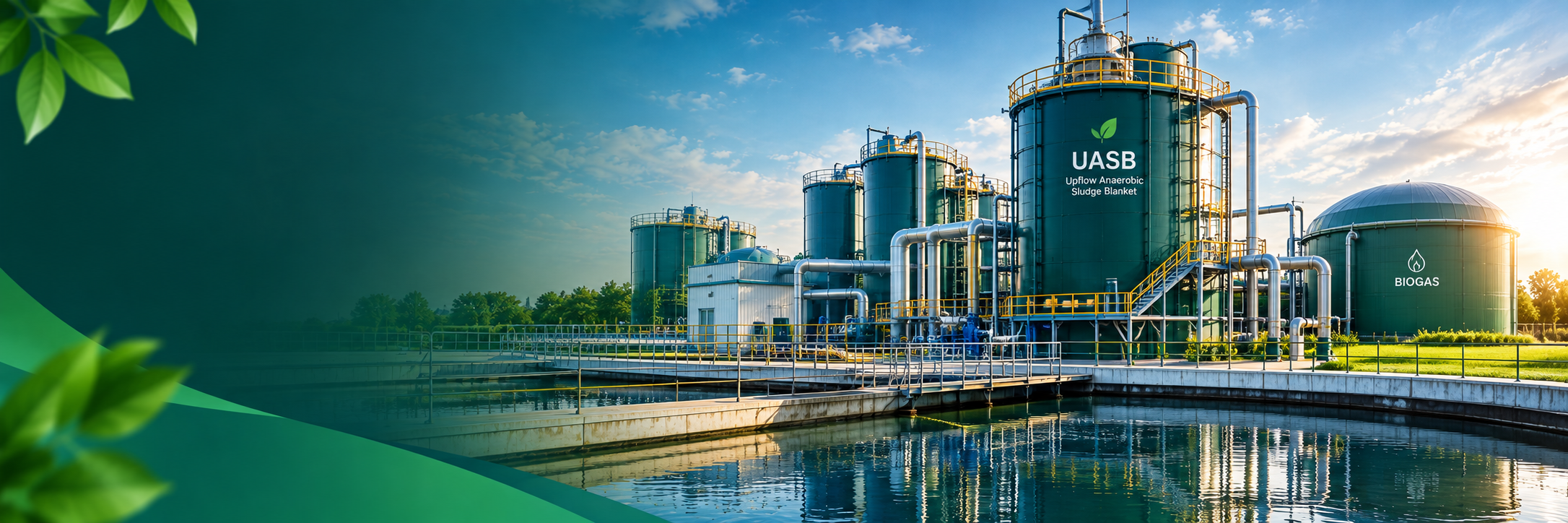
Upflow Anaerobic Sludge Blanket (UASB)
"Newtos Enviro India Pvt. Ltd." was established in 2014 as a Manufacture, Trader, Service provider and wholesaler.
"Newtos Enviro India Pvt. Ltd." was established in 2014 as a Manufacture, Trader, Service provider and wholesaler.
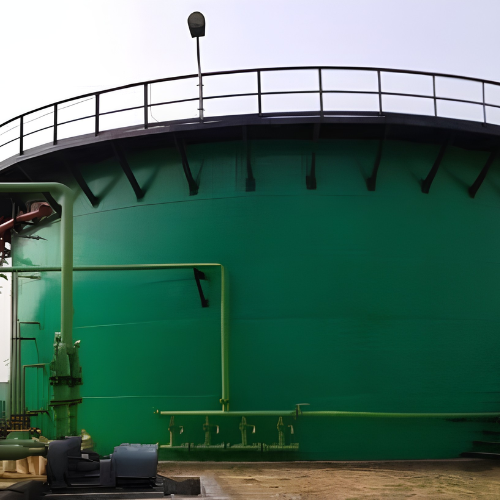
Upflow Anaerobic Sludge Blanket, commonly known as UASB, is a form of anaerobic digester used for wastewater treatment.
In the UASB process, wastewater flows upward through a blanket of granular sludge. Anaerobic microorganisms present in the sludge blanket degrade the organic matter as the wastewater passes through the reactor.
The upward flow and settling action help maintain the sludge blanket inside the reactor while the anaerobic biological process treats the wastewater.
Wastewater moves upward through the suspended sludge blanket inside the reactor.
A concentrated blanket of anaerobic sludge supports biological degradation within the reactor.
Methane-rich biogas can be generated as a by-product of the anaerobic treatment process.
The UASB process uses upward wastewater flow and anaerobic microorganisms to degrade organic matter within the sludge blanket.
Wastewater enters the reactor from the lower section.
The wastewater flows upward through the sludge blanket.
Anaerobic microorganisms degrade organic matter in the wastewater.
Methane-rich biogas is produced as a by-product of the anaerobic process.
UASB technology operates through an anaerobic biological process. During treatment, organic material is degraded by microorganisms within the sludge blanket.
One notable by-product of the process is methane-rich biogas, which can potentially be captured and used as an energy source.
UASB provides an anaerobic approach to wastewater treatment with biological degradation and methane-rich biogas generation.
Biological wastewater treatment takes place without conventional aerobic aeration.
The process produces methane-rich biogas that may be captured for energy applications.
Granular sludge remains suspended and supports the anaerobic biological process.
UASB technology can be applied as part of industrial wastewater treatment systems.
Newtos Enviro has listed a UASB project for Premas Biotech, Manesar, involving supply, installation and commissioning of the UASB system.